
This puppy age chart gives the rough milestones: baby teeth come in around 3 to 6 weeks, puppies wean near 8 weeks, adult teeth arrive by about 6 to 7 months, and small dogs mature around 10 to 12 months while large breeds take 18 to 24 months. By AVMA guidance, a dog’s first year equals about 15 human years.
Quick takeaways
- The first three months are the key socialization window.
- Adult teeth start replacing baby teeth around 4 months, and most puppies have all 42 adult teeth by 6 to 7 months.
- Small and medium dogs reach adulthood around 10 to 12 months, large and giant breeds around 18 to 24 months.
- The old “one dog year equals seven human years” rule isn’t accurate.
- Small dogs are usually considered senior around 7, larger breeds around 5 to 6.
In this guide
- What does a puppy age chart by week look like?
- What does a puppy age chart by month look like?
- How can you tell a puppy’s age by its teeth?
- What age is my dog in human years?
- Does a male puppy grow on a different schedule?
- When is a dog considered a senior?
- How should you use your puppy’s age?
- Frequently asked questions
Puppies change fast. The tiny, wobbly ball of fur from week three is a leggy teenager by month six. This puppy age chart lays out what usually happens when, from the first teeth to adulthood, and shows how to translate your dog’s age into human years without relying on the old seven-year rule.
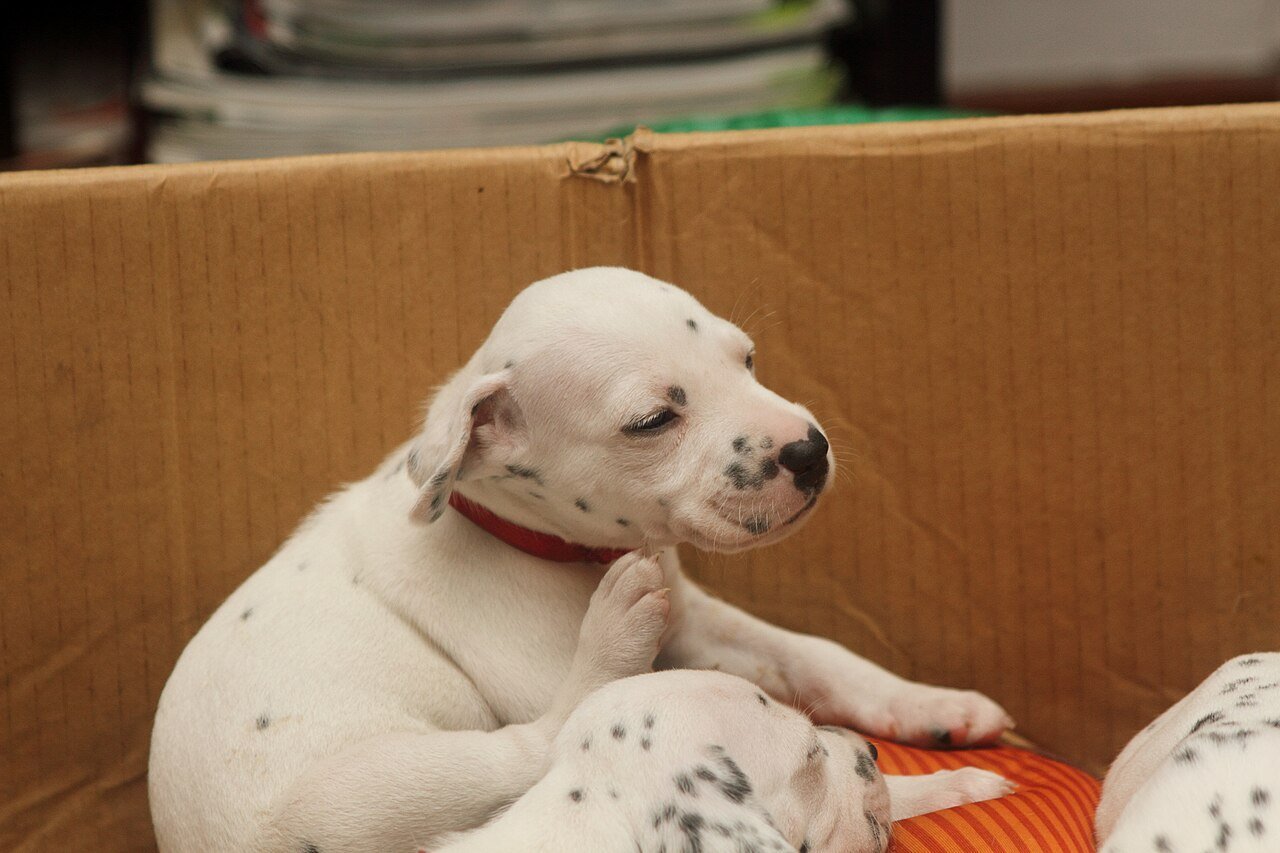
What does a puppy age chart by week look like?
These are typical milestones. Every puppy and breed develops at its own pace, so think of them as rough timing, not deadlines.
| Age | What’s usually happening |
|---|---|
| Birth to 2 weeks | Eyes and ears closed, sleeping and nursing most of the day |
| About 2 to 3 weeks | Eyes and ears open, first wobbly steps |
| 3 to 6 weeks | Baby teeth erupt, play with littermates begins |
| 6 to 8 weeks | Weaning onto puppy food, very curious and social |
| 8 weeks | Typical age puppies go to new homes, start of vaccine series |
| 8 to 12 weeks | Big socialization period, potty training and name learning begin |
| 12 to 16 weeks | Socialization window starts to close, vaccines continue |
The American Veterinary Society of Animal Behavior calls the first three months the primary window for socialization. For more detail on each stage, see our guide to puppy development stages.
What does a puppy age chart by month look like?
| Age | What’s usually happening |
|---|---|
| 3 months | Rapid growth, lots of chewing, learning basic cues |
| 4 months | Adult teeth start coming in, puppy coat may start shedding |
| 5 to 6 months | Teething winds down, energy climbs, testing limits |
| 6 to 7 months | Most adult teeth are in, adolescence begins |
| 6 to 12 months | Teen phase, sexual maturity in many dogs, growth slows in small breeds |
| 10 to 12 months | Small and medium breeds reach adult size |
| 18 to 24 months | Large and giant breeds finish growing |
The growth timing comes from VCA Animal Hospitals, which says small and medium breeds mature by about 10 to 12 months and large and giant breeds by about 18 to 24 months. Track weight along the way with our puppy growth chart.

How can you tell a puppy’s age by its teeth?
Teeth are one of the best clues to a young puppy’s age. The Merck Veterinary Manual lists typical eruption times for dogs. Rounded off, they look like this:
| Teeth | Rough age they appear |
|---|---|
| Baby incisors (front teeth) | 3 to 5 weeks |
| Baby canines (fangs) | 3 to 4 weeks |
| Baby premolars | 4 to 6 weeks |
| Adult incisors | About 4 to 5 months |
| Adult canines | About 5 to 6 months |
| Adult premolars and molars | About 4 to 7 months |
VCA notes that puppies have 28 baby teeth and adult dogs have 42 teeth, and that most puppies have their adult teeth by 6 to 7 months. So if a puppy has only baby teeth, it’s likely under 4 months. A mix of baby and adult teeth suggests about 4 to 6 months. Learn more in our guide to a puppy losing teeth.
Teeth are a less reliable guide in adult dogs, since wear depends on chewing habits and diet. Your vet can give you a best estimate.
What age is my dog in human years?
The idea that one dog year equals seven human years has been around since the 1950s, but the AKC’s dog years guide points out that it’s not accurate. Dogs mature much faster in the first two years, then age more slowly.
The AKC cites this general guideline from the American Veterinary Medical Association for a medium-sized dog:
- Year 1 equals about 15 human years.
- Year 2 adds about 9 more.
- Each year after that adds about 5.
Here’s what that looks like:
| Dog’s age | Approximate human years (medium dog) |
|---|---|
| 1 | 15 |
| 2 | 24 |
| 3 | 29 |
| 4 | 34 |
| 5 | 39 |
| 6 | 44 |
| 7 | 49 |
| 8 | 54 |
| 10 | 64 |
| 12 | 74 |
Small dogs often age a little slower after maturity, and large dogs age faster. The AKC notes that large breeds tend to have shorter lives, so a big dog may be “older” than this chart shows.

What about a puppy’s age in human years?
There’s no precise conversion for puppies under a year. A loose comparison helps: a 2 to 3 month old puppy acts a lot like a toddler, a 6 month old is a lot like a preteen, and a 9 to 12 month old is much like a teenager. Treat those as a way to picture behavior, not science.
Does a male puppy grow on a different schedule?
Males and females follow the same general timeline. In many breeds, males end up a bit bigger and may take a little longer to fill out. Your puppy’s adult size depends mostly on breed, genetics and nutrition.
When is a dog considered a senior?
According to the AVMA, as quoted by the AKC, small dogs are generally considered senior around 7 years old, while larger breeds are often considered senior at 5 to 6. That’s when vets start seeing more age-related problems. It’s a good time to ask about senior checkups.
How should you use your puppy’s age?
Age guides a lot of puppy care:
- Feeding. Meal size and frequency change as your puppy grows. See how much to feed a puppy.
- Exercise. Young puppies need short, gentle play, not long runs. Our puppy exercise chart breaks it down by age.
- Vaccines and vet visits. The puppy vaccine series usually runs until about 16 weeks or older.
- Training. Short, fun sessions work at any age, and the earlier you start, the easier it is.
Your vet is the best source for your puppy’s exact needs, especially if you’re not sure how old your puppy is.
Frequently asked questions
What age is no longer a puppy?
Most small and medium dogs are adults by about 10 to 12 months, according to VCA, while large and giant breeds keep maturing until about 18 to 24 months. Many dogs keep puppyish behavior a while longer, especially through adolescence.
What age is my dog in human years?
As a general guideline cited by the AKC from the AVMA, the first year of a medium-sized dog’s life equals about 15 human years, the second year adds about 9, and each year after that adds about 5. So a 3-year-old medium dog is roughly 29 in human years. Size changes the math.
What age is my dog?
If you don’t know your dog’s birthday, your vet can estimate age from the teeth, body and overall condition. In puppies, which teeth have come in gives a fairly good estimate. In adults, the estimate is rougher and may be off by a few years.
What age is my dog a senior?
The AVMA says small dogs are generally considered senior at about 7, while larger breeds, which tend to have shorter lives, are often considered senior at 5 to 6. Your vet may suggest more frequent checkups from then on.
How old is my puppy?
Check the teeth. Baby teeth come in from about 3 to 6 weeks, and adult incisors begin replacing baby teeth around 4 months. A puppy with a full set of adult teeth is likely at least 6 to 7 months old. Your vet can give a closer estimate.
Vet note: This article is general information and is not a substitute for advice from your own veterinarian. If your puppy is having trouble breathing, collapses, has a seizure or may have eaten something toxic, call your vet or the nearest emergency animal hospital right away. ASPCA Animal Poison Control: 888-426-4435 (a fee may apply).
